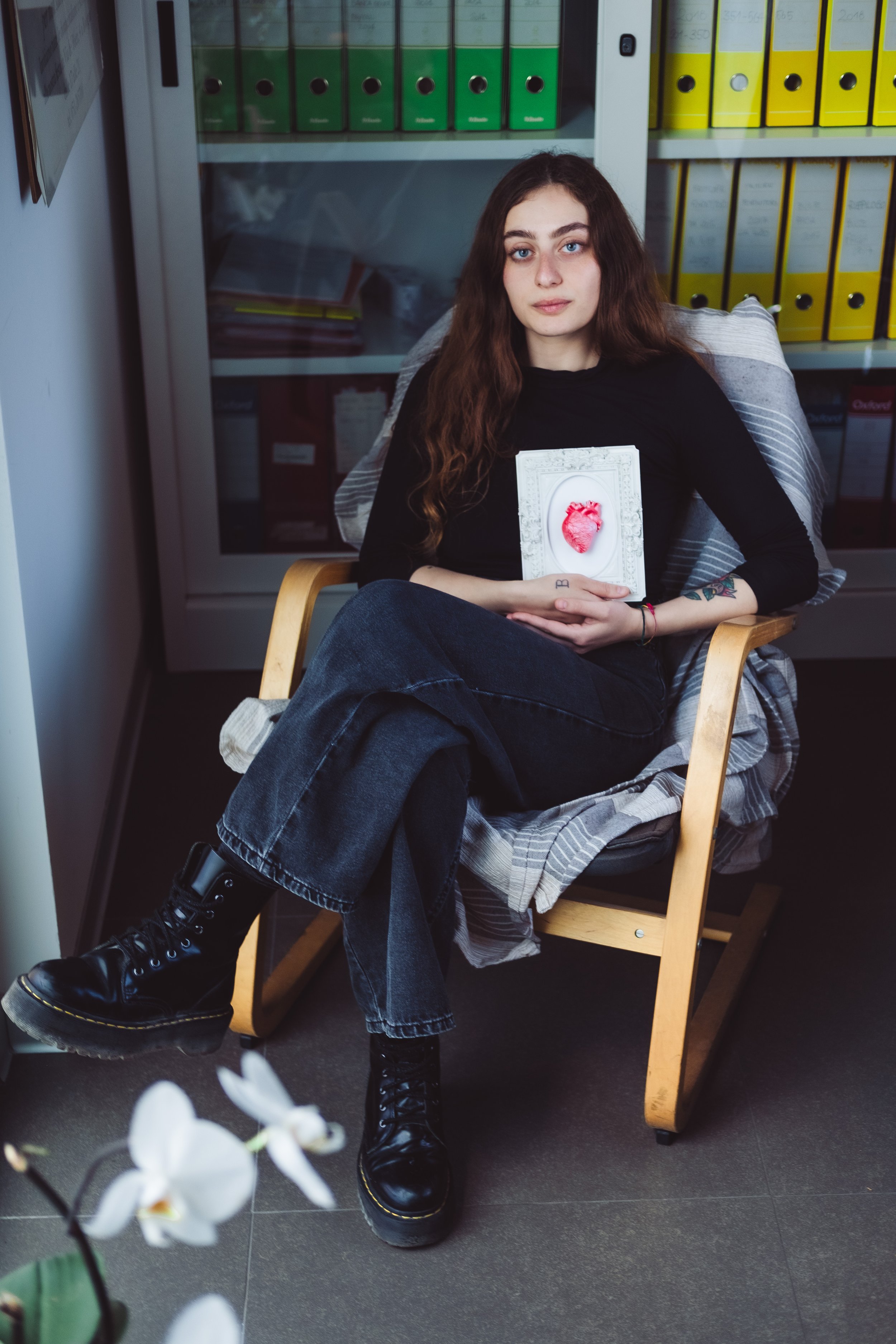
Bologna, April 2025
How does Casa delle Donne support women in rebuilding a sense of home and belonging?
‘The first step in rebuilding a sense of home for many women is the relationship that forms between the woman and the support worker. This relationship does not replicate dynamics of power or paternalism, but is instead grounded in empathy and mutual respect. The sense of safety and also of shared responsibility that emerges within this relationship often becomes fertile ground for change.’
How has working in this environment influenced your own perception of home?
‘I believe this reflection can be held both personally and collectively. Speaking for myself — Carmen — I can say that the environment of the Casa delle Donne allowed me to understand how a space inhabited by women, even if unfamiliar at first, can become a place that feels like home. In Italy, our concept of “family” is the product of many traditions, often imagined as a space to be protected and defended. The house and everything tied to it is frequently seen more as a fortress than anything else. Personally, I believe this contributes to the spread of nationalist ideologies or, more broadly, attitudes that are hostile to openness and the encounter with others. Experiencing a space like the Casa delle donne enables a continuous process of growth, not only feminist, but also human and political in a broader sense. I believe we must commit ourselves to protecting women’s shelters across the country, because, like other spaces currently under threat, they represent places where one can practice self-care and care for others and, in doing so, collective care. As for the organization as a whole, I think I can speak for all of us when I say that working in an anti-violence center makes it impossible to reduce things to simplistic narratives. Our understanding of “home” has multiplied and that is a good thing. We recognize that we often operate from positions of privilege for instance, we are all white and we continue to learn that situating ourselves, even in the way we construct narratives (such as the one around “home”), is a deeply important political act.’
What is the primary role of a women’s shelter?
‘The primary role of women’s shelter center is to welcome women who are experiencing violence and to support them in their journey toward liberation from violence. In particular, our women’s shelter follows a feminist methodology that focuses on repositioning the woman at the center. We believe this is a fundamental approach, as violence and the patriarchal culture we live in often deprive women of their agency.
Indeed, the goal of each woman’s path is to achieve both well-being and autonomy. In the capitalist world we live in, we know how complex this can be from an economic standpoint; furthermore, in a city like Bologna, we constantly face the issue of a housing crisis. Added to this is the fact that the women who come to us often face multiple, intersecting vulnerabilities.
In any case, we respect each woman’s choices and desires, supporting her without an assistentialist approach. Another key goal of the Casa delle Donne is to promote cultural change: we believe that violence is not the result of isolated episodes or sudden impulses, but rather of a cultural and social continuum that normalizes violent behavior and perpetuates stereotypes. The organization of events, trainings, and social media campaigns aims precisely at this objective.’
What are some of the most common emotional challenges women face when they arrive here?
‘Our feminist approach also rejects the paradigm of the woman who survives violence being portrayed solely as a victim, as this denies her agency and complexity, ultimately reproducing the same dynamics as the patriarchal culture in which she is immersed. Each journey follows different rhythms and patterns. Often, it is particularly difficult to name what one has experienced: yet naming the violence is also the first crucial step to take action and to transform the personal into the political. Emotional difficulties are compounded by material or practical challenges, such as caring for children, fear of losing one’s home or job. The journey out of violence is, above all, a profound exercise in self-care, and it often requires great effort before full well-being can be achieved.’
Have you noticed any recurring themes in how women describe their sense of home?
‘We believe that the concept of “home” can hold multiple meanings for a woman who has survived violence. For some, home, including the Casa delle Donne per non subire violenza is a safe space where they can reconnect with and nurture a sense of self. One of the goals of feminism, including the feminism that gave rise to our organization was to expose the widespread nature of domestic and intimate partner violence. Home, therefore, is not always a safe place; in fact, it is often, both metaphorically and literally, the very place where violence is perpetrated. The notion of home can become even more complex when a woman has a migratory background. Even in these cases, we do not want to simplify — as we said earlier, each journey is different, each woman is different, and the stories they share about their homes and their experiences are valuable precisely because of their uniqueness. We should affirm and embrace that uniqueness in its entirety to be able to start a political and collective reflection. ‘
BEHIND THE SCENES & INTERVIEW